Why Jakarta Makes Dispatch Harder Than Most Cities
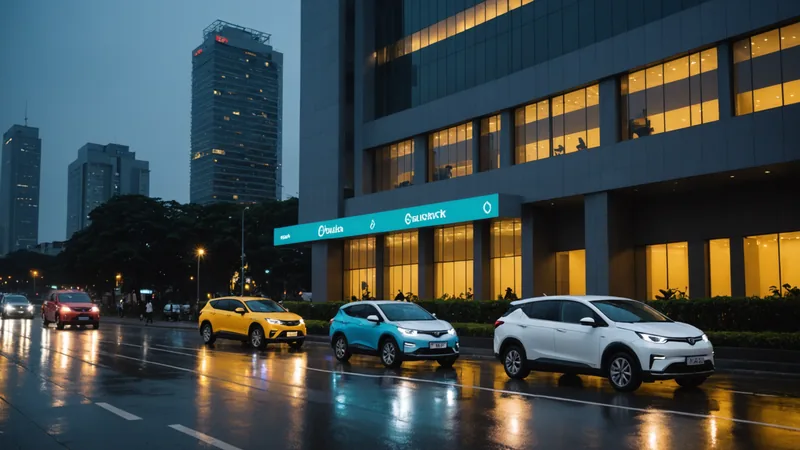
At 08:00 on a rainy Monday, a trip on Jalan Sudirman can take 40 to 60 percent longer than its nominal duration. Peak-hour speeds in Jakarta's central business district are consistently among Southeast Asia's slowest. Generic dispatch frameworks are not built for that gap.
For ICE ride-hailing, this creates reputational and financial range anxiety rather than electrical risk. EV fleets face both. An EV leaving Tebet for a Kebayoran Lama pickup at 34 percent SoC may be expected to complete the trip and return within range, only for traffic to add 25 minutes and break that calculation.
This risk is grounded in repeated conversations with Jakarta fleet coordinators during our early product development. The usual response was a conservative rule keeping low-battery vehicles off longer trips, often held in the coordinator's mind instead of encoded in the system. That approach breaks down when one coordinator handles eight requests across ten vehicles and four charger ports. Under that load, mental thresholds become inconsistent.
The Data Model Behind Jakarta Dispatch
Jakarta EV ride-hailing dispatch must bring together inputs that standard dispatch tools usually keep separate:
- Real-time SoC per vehicle, updated at every trip completion and via telematics polling during charging sessions.
- Charger slot availability, including which ports are occupied, which have vehicles that have finished charging but not been moved, and which are in fault state.
- Zone-level demand patterns, learned from historical trip request distribution by time of day, day of week, and area. Jakarta demand concentrates predictably near office towers, transit hubs, and commercial centers at specific times.
- Estimated trip duration, adjusted for current traffic conditions, not nominal distance. An 8-km trip in Senayan at 08:15 requires a very different range budget than the same 8 km at 14:00 on a Sunday.
Vehicle assignment is a joint decision: which available vehicle best fits the request based on energy state, location, and schedule, while leaving the wider fleet prepared for what comes next.
EV Range Planning by Concentration Zone
Jakarta ride-hailing demand shifts by location and time. From 06:30 to 09:30, morning demand runs from southern and eastern residential areas toward the Sudirman-Thamrin corridor and Tanah Abang-Palmerah. From 16:30 to 20:00, the flow reverses, while Grogol and Kelapa Gading join the busiest zones.
For an EV operator, assigning vehicles to zones at the start of a peak affects later charging recovery. A vehicle making three straight south-to-central trips may reach Monas at 09:45 with 22 percent SoC and no open DC fast-charger port within 3 km. That problem began with a dispatch choice two hours earlier.
Zone-aware dispatch anticipates this by rating assignments on both immediate fit and projected SoC at the session's expected end position. Traffic variability prevents perfect forecasts. Still, accounting for zone position and charger proximity consistently beats simply matching the closest vehicle with the nearest request.
What Optimization Means for a Small Fleet
For a 10 to 20 vehicle fleet, dispatch optimization does not require a complex mixed-integer program every 15 seconds. It means applying clear, consistent rules that a coordinator or software layer can use under pressure without rebuilding the logic each time.
The clearest improvements in our early-access pilot scenarios came from these rules:
- No trip assignment to vehicles below 35 percent SoC unless a confirmed charger port is on the route and the trip can complete round-trip within the available range.
- Reserve at least two vehicles above 70 percent SoC during morning peak to handle late airport requests, which tend to be long and time-sensitive.
- Flag vehicles that have been finished charging but are still occupying a port for more than 20 minutes, and route the next available driver to move them before dispatching them on a trip.
These are practical algorithms, not exotic ones. They formalize operational experience and apply it consistently. The key difference is whether a coordinator recalls the rules during a busy morning or software applies them from a defined rule set.
The Limits of Dispatch Optimization
Dispatch optimization cannot make up for inadequate charging infrastructure. A fleet of 15 vehicles with 6 AC charging ports facing 14 hours of peak demand has a physical shortfall no model can solve. Optimization can cut wasted charging time and reduce low-SoC dispatches, but it cannot add missing energy capacity.
Algorithmic dispatch is not always better than an experienced coordinator. Someone who has run the same routes for three years may know patterns absent from a model trained on 90 days of data. Optimization is most valuable for managing edge cases under load, not for replacing operational expertise.
In early pilot work, the largest gains consistently came from showing existing information together at dispatch time. A coordinator who can view vehicle SoC, charger-port status, and zone demand in one place, rather than switching among three apps and a group chat, can decide better. The model adds a layer to that visibility, it does not replace it.
What We Are Building Toward
The RideBlitz Jakarta dispatch model includes PLN tariff windows, traffic-speed patterns by corridor and time of day, and zone demand observed in early-access fleet data. We started with Jakarta because its constraints are harder than those in most cities. A model that works there can be calibrated for simpler settings more easily than the reverse.
The near-term focus is 07:00 to 10:00 and 17:00 to 20:30, when demand concentration and EV range pressure overlap most sharply. These periods offer the clearest effect on revenue per vehicle per day.